Blog Archive

Friday, July 25, 2025

On the Transmission of Mythology and the Paradox of Cultural Alienation

On the Transmission of Mythology and the Paradox of Cultural Alienation


In the study of comparative mythology and the history of religious thought, it becomes evident that many of the world’s dominant religious systems namely Christianity and Islam are deeply rooted in the mythological framework of ancient Judaism. This is not a judgment, but rather a widely acknowledged historical and theological fact. The narratives of creation, prophecy, divine law, and eschatology found in the Hebrew Bible (Tanakh) were adopted and adapted into the New Testament and the Qur’an, forming the backbone of Christian and Islamic theology. Scholars such as Mircea Eliade, Joseph Campbell, and Karen Armstrong have written extensively about the structural continuity and symbolic repetition among these traditions. For example, the story of Adam and Eve, the figure of Abraham, the exodus of Moses, and the concept of a messianic age all originate in Jewish texts but are central to both Christian and Islamic belief systems. Islam, in particular, preserves numerous Jewish laws and customs, including dietary practices and male circumcision (Brit Milah in Judaism and Khitan in Islam), further underscoring the continuity. What is paradoxical and sociologically significant is that while these mythologies have been embraced and disseminated globally through Christianity and Islam, the people from whom these narratives originally emerged the Jewish people have often been marginalized, persecuted, or othered by the very societies that adopted their stories. This cognitive dissonance, as noted by thinkers such as Sigmund Freud in Moses and Monotheism, points to a complex interplay of admiration, appropriation, and antagonism.


This phenomenon becomes even more striking when viewed from the perspective of cultures with rich indigenous mythologies of their own, such as those of Iran (with the Avesta and the Shahnameh), India (the Vedas, Mahabharata, and Ramayana), or ancient Greece (the Iliad and Odyssey). In these traditions, mythology is not merely narrative it is identity. As Carl Gustav Jung observed, myth is a language of the collective unconscious; it structures how a people perceive the world and themselves. When a culture replaces or suppresses its own symbolic foundations with those of another, especially under the pressures of conquest, colonization, or dogmatic religion, a kind of cultural alienation can occur. This is not an argument against any tradition, nor a denial of the beauty or depth of Jewish mythology—on the contrary, it is a call to appreciate it for what it is: a distinct and meaningful cosmology that belongs to the Jewish people. At the same time, it is an invitation for all cultures to re-engage with their own mythopoetic heritage not in opposition to others, but in the spirit of cultural integrity and pluralism. In an era of global interchange, recognizing the origin of shared stories, and honoring both their roots and the diversity of human imagination, may be a step toward deeper understanding and reconciliation.


Aram Ruhi Ahangarani

June 5, 2025 / 15 Khordad – Year 7044 Iranian / 2584 Imperial


دربارهٔ گذر اسطوره‌ها و ناسازواری بیگانگی فرهنگی


در شناخت و بررسی اسطوره‌ها، و در پژوهش تاریخ اندیشه‌های دینی، روشن می‌شود که بسیاری از دین‌های نامدار جهان چون کیشِ ترسا و دینِ اسلام، ریشه‌هایی ژرف در اسطوره‌های کهن یهودی دارند. این سخن نه داوری‌ست، نه نکوهش، بلکه نکته‌ای‌ست پذیرفته‌شده در تاریخ و دین‌پژوهی. روایت‌هایی چون آفرینش، پیامبری، شریعت آسمانی و فرجام‌شناسی، نخست در «تنخ» (کتاب‌مقدس عبری) آمده‌اند، و سپس در «عهد جدید» و «قرآن» بازتاب یافته‌اند؛ و ستون‌پایهٔ دین‌های ترسا و اسلام را ساخته‌اند. پژوهشگرانی چون میرچا الیاده، جوزف کمپبل و کارن آرمسترانگ به‌تفصیل دربارهٔ ساختارهای همسان و تکرارهای نمادین در این سنت‌ها نوشته‌اند.
برای نمونه، داستان آدم و حوا، روایت ابراهیم، کوچ موسی، و باور به فرارسیدن دوران موعود، همگی ریشه در متون یهودی دارند، ولی به‌کلی در دل باورهای ترسا و اسلامی نشسته‌اند. به‌ویژه اسلام، آیین‌ها و شریعت‌های بسیاری از دین یهود را نگه داشته است، از جمله قوانین خوراکی و آیین ختنه (که در یهود به نام برِیت میلا و در اسلام ختان خوانده می‌شود)، که پیوستگیِ میان این دین‌ها را بیش از پیش نمایان می‌سازد.
آن‌چه این میان شگفت‌انگیز و در نگاه جامعه‌شناسانه بس درخور اندیشه است، این است که در حالی‌که این اسطوره‌ها از راه دین‌های ترسا و اسلام در سراسر گیتی گسترده شدند، مردمانی که نخستین‌بار این روایت‌ها از ایشان برآمد، یعنی قوم یهود، بارها به حاشیه رانده شدند، آزار دیدند یا از سوی همان جوامعی که اسطوره‌هایشان را برگرفتند، بیگانه و دیگرپنداشته شدند. این ناسازواری روانی، چنان‌که زیگموند فروید در کتاب «موسی و یکتاپرستی» اشاره کرده، پرده از پیوندی پیچیده میان ستایش، بهره‌برداری و دشمنی برمی‌دارد.

این پدیده، از دریچهٔ فرهنگ‌هایی که اسطوره‌های بومی و پرمایهٔ خود را دارند، چون ایران (با اوستا و شاهنامه)، هند (با وداها، مهابهاراتا و رامایانا)، یا یونان کهن (با ایلیاد و ادیسه)، از آن هم چشمگیرتر است. در این فرهنگ‌ها، اسطوره تنها داستان نیست؛ هستی‌شناسی‌ست. چنان‌که کارل گوستاو یونگ یادآور شده، اسطوره زبان ناخودآگاهِ همگانی‌ست؛ زبانی که بنیادهای اندیشه، خودشناسی و جهان‌نگری یک ملت را می‌سازد. هنگامی که فرهنگی، نمادها و اسطوره‌های خود را کنار می‌نهد و به‌جای آن، روایت‌های بیگانه را، خواه به‌زور دین، خواه زیر فشار کشورگشایی یا سیاست استعماری، برمی‌گزیند، بیگانگی‌ای ژرف با هویت درونی روی می‌دهد.
این نوشتار، نه بر ضد هیچ دین یا باور خاصی‌ست، و نه در پیِ کاستن از زیبایی یا ژرفای اسطوره‌های یهودی‌ست؛ برعکس، فراخوانی‌ست برای شناخت و پاس‌داشت آن‌چه که هست: کیهان‌شناسی‌ای یگانه و پرمایه که از آنِ مردمان یهود است. هم‌زمان، این سخن، دعوتی‌ست برای همهٔ فرهنگ‌ها که دوباره با میراث اسطوره‌ای خود پیوندی زنده و سازنده بیابند. نه از سرِ ستیز با دیگران، بلکه برای پاس‌داشت یکپارچگی فرهنگی و همزیستیِ فکری.
در روزگاری که فرهنگ‌ها در هم می‌آمیزند و روایت‌ها به‌سرعت می‌چرخند، بازشناخت خاستگاه داستان‌های مشترک، و ارج‌نهادن به ریشه‌ها و گوناگونی خیال انسانی، شاید گامی باشد به‌سوی شناخت ژرف‌تر و آشتی راستین.

آرام روحی آهنگرانی

۵ ژوئن ۲۰۲۵ / ۱۵ خرداد ۷۰۴۴ ایرانی / ۲۵۸۴ شاهنشاهی

Saturday, January 18, 2025

Aram Ruhig at Vebikus Kunsthalle Schaffhausen – 40th Anniversary Exhibition


Aram Ruhig at Vebikus Kunsthalle Schaffhausen – 40th Anniversary Group Exhibition


January 18 – March 2, 2025


Aram Ruhig (aka Aram Ruhi Ahangarani, b. 1982) participated in the jubilee exhibition celebrating the 40th anniversary of Vebikus Kunsthalle Schaffhausen. The show featured 40 artists selected from those who have exhibited at Vebikus since its founding in 1985, highlighting the gallery’s rich history and its ongoing contribution to the regional art scene. Curated collectively by Vebikus members, the exhibition presented a diverse array of paintings, sculptures, installations, and video works, spanning both historic and contemporary creations.


Ruhig exhibited two works from his series Material Harmonies: Mysticism in Poetic Landscapes:


The Conversation, 2023, oil on canvas

Dancing in the Dark, 2023, oil on canvas


Drawing inspiration from Zoroastrian theology, Ruhig explores the dynamic interplay between the material and the mystical. “My paintings function as compositions aligning earthly elements with spiritual themes, akin to a symphony of colors and forms,” he explains. His work seeks to transcend cultural boundaries while evoking universal human experiences.


The exhibition was held at:

Vebikus Kunsthalle Schaffhausen

Kulturzentrum Kammgarn

Baumgartenstrasse 19, CH-8201 Schaffhausen

www.vebikus.ch


Friday, January 26, 2024

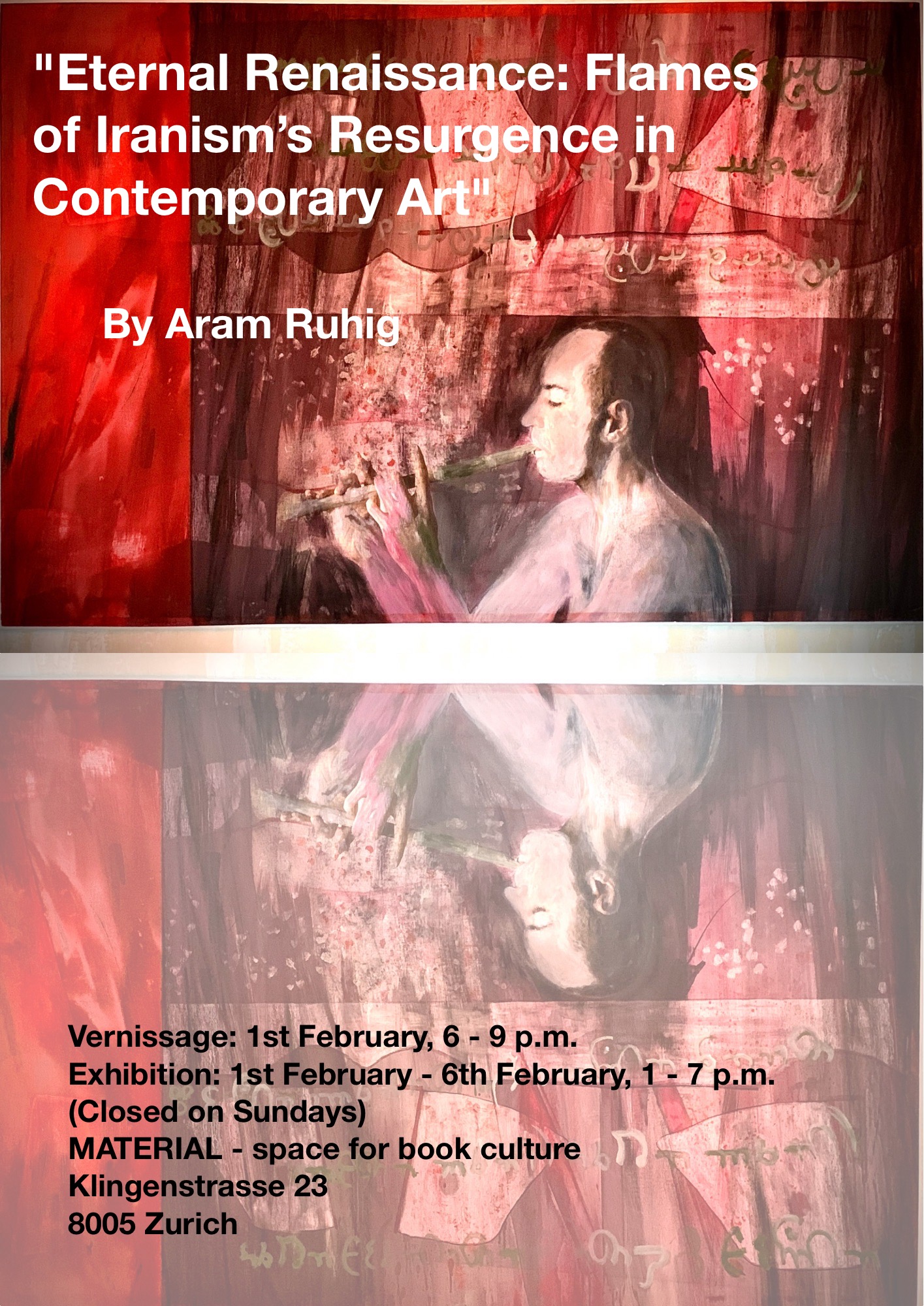
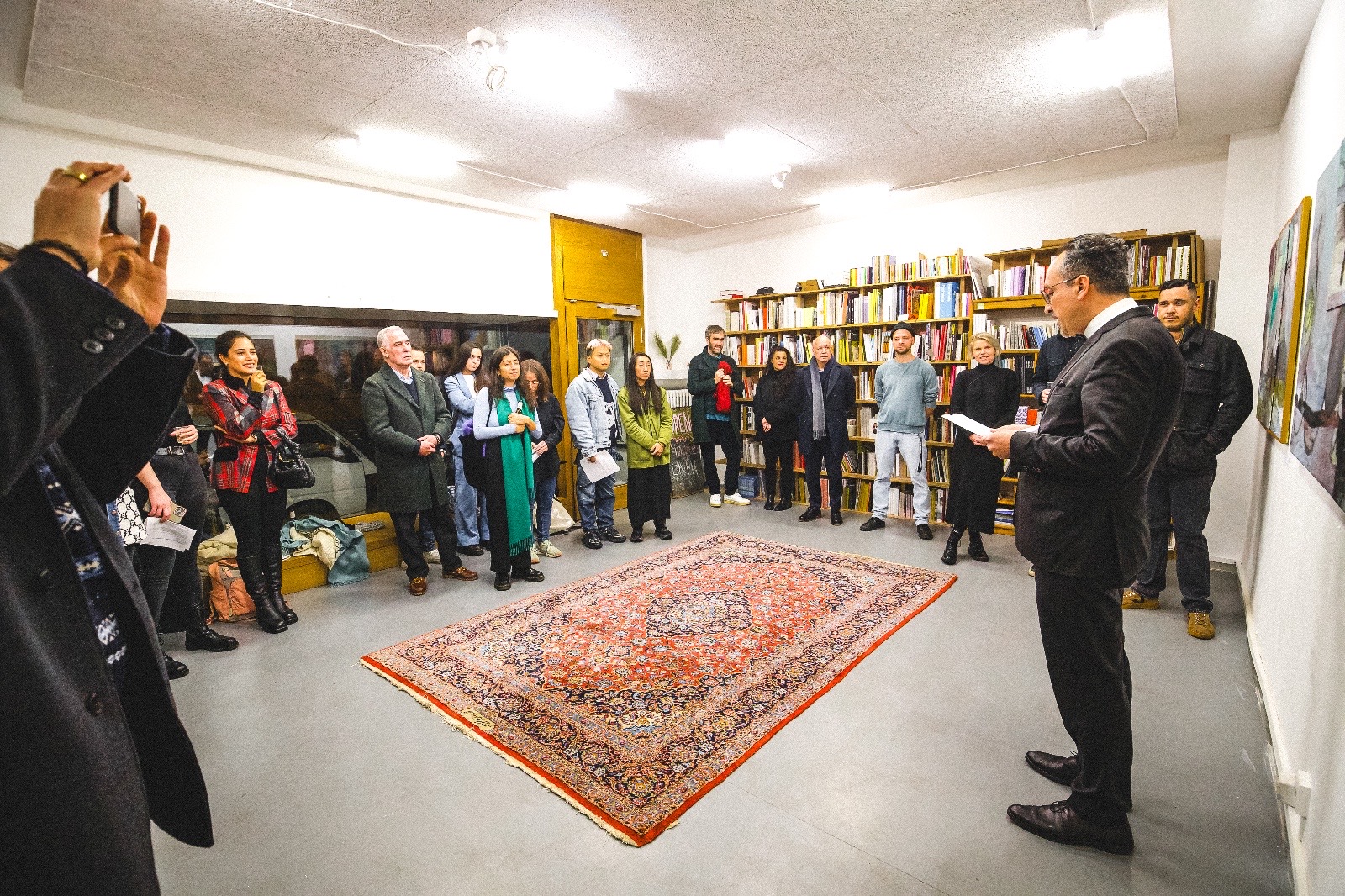
"Eternal Renaissance: Flames of Iranism’s Resurgence in Contemporary Art" By Aram Ruhig


Eternal Renaissance: Flames of Iranism’s Resurgence in Contemporary Art


Aram Ruhig’s work invites viewers into a poetic, immersive space where mysticism, transformation, and the ongoing journey toward the authentic self and artistic expression intertwine. Rooted in the deep philosophical traditions of Persian civilization, his paintings and media works reimagine ancient narratives in a contemporary form, carrying forward a heritage of artistic renewal.


At the heart of this exhibition is the idea of eternal renaissance a civilization that, despite upheavals, continuously reinvents itself. Through layers of movement, light, and symbolism, Aram Ruhig explores the relationship between material and spiritual existence, questioning the boundaries between seen and unseen, presence and absence. His work bridges the poetic and the visual, creating compositions that invite reflection on transformation and continuity.


Drawing from the mystical and literary traditions of Hafez, Ferdowsi, and Zoroastrian philosophy, his works echo a timeless search for harmony. Love and participation stand at the core of this journey an invitation to engage with existence not through identification, but through the experience of the true self.


The Persian garden serves as a symbol of balance in differences, not as a fixed paradise, but as a space of continuous growth, movement, and becoming much like a musical composition where diverse elements come together in harmony and serves as a metaphor throughout Aram Ruhig’s work. It represents not only an earthly paradise but also a reflection of a material-spiritual dialogue where diversity, fluidity, and transformation create a visual symphony.


In Eternal Renaissance, mysticism is not an escape but a re-engagement, a reimagining of past and future as one evolving entity. Through this lens, Aram Ruhig invites us to step into an artistic realm where poetic tradition and contemporary vision merge, keeping the eternal flame of creative expression alive.


by: Aram Ruhig

Curator: Oliver Rico

Organiser: MATERIAL 


Wednesday, April 12, 2017

Aram Ruhig


I was born in Tehran and have lived in Zurich since 1998. My work explores perception, transformation, and immersive experience through painting, video, and media poetry. I create visual environments where movement, light, and symbolism form layered dialogues, inviting viewers to engage beyond the visual, into the poetic and the unseen.

My artistic journey began at IIDCYA in Tehran, where I was influenced from a young age by prominent artists, including Abbas Kiarostami. Later, I studied fine art in Zurich, and since 2011, I have curated RuhigRaum, a space dedicated to artistic exploration.

..................................................................................


"My "I" is quiet, but it records everything."

I, 
the room. 
I, the room. 
I designate myself as room. 
Silent room (RuhigRaum) is: the rooms I have been living in. 
I have been working in these rooms. 
My work is: search, 
that is the search itself which I'm interested in, 
the processes of my life and their connections among themselves are a sign of something. 
Through my search in these rooms they have changed more and more, 
more and more they hint at something, 
yet this something cannot be grasped, 
this something is silent. 
This something lives in the silence. 
I wish however that one can experience this in the rooms. 
I am the room and I would like to be experienced by people entering the rooms I have shaped. 

An open room am I, 
it's about the lines, colours, structures and compositions that influence me, and I cannot ignore them and I don't want to have to ignore them, because my life always takes place in these rooms, 
thus I have a connection to everything, 
but sometimes there is a conflict relationship with a lot of characteristics of the rooms, 
and through the conflict, arises an act that I absolutely want to perform, 
and here the image or the word comes to my help.

It's about an alienated view on life. 
A life and a view upon between dream and reality. 
Perhaps it is, about a pending decision, 
to communicate, to participate or precisely not.
Foreign to me is a lot around me 
or maybe I am the foreigner.

Aram Ruhi Ahangarani 

..................................................................................


"Mein Ich ist ruhig, es zeichnet aber alles auf."

Ich, 
der Raum, 
Ich der Raum. 
Ich bezeichne mich als Raum. 
RuhigRaum ist: die Räume, die ich bewohne. 
Ich arbeite in diesen Räumen, 
meine Arbeit ist: suchen, 
das ist die Suche selbst, die mich interessiert, 
die Prozesse meines Lebens und deren Verbindung untereinander deuten  auf etwas hin. Durch meine Suche in diesen Räumen haben sie sich immer mehr verändert, 
sie deuten immer mehr hin auf etwas, 
jedoch das Etwas kann nicht gefasst werden, 
das Etwas ist ruhig.  
Das Etwas lebt in der Stille. 
Ich will aber, dass man dies in den Räumen erleben kann. 
Ich bin der Raum und möchte, dass man mich erfährt, 
indem man die Räume betritt, die ich gestaltet habe.

Ein offener Raum bin ich, 
es geht darum, 
dass die Linien, Farben, Strukturen und Komposition in den Räumen mich beeinflussen, und ich kann sie nicht ignorieren und will sie auch nicht ignorieren müssen, da sich mein Leben immer in diesen Räumen abspielt, 
so habe ich mit allem eine Beziehung, 
es gibt aber manchmal einen Beziehungskonflikt mit vielen Eigenschaften von den Räumen, 
und durch den Konflikt entsteht ein Akt, 
den ich unbedingt aufführen muss, 
da kommt das Bild oder das Wort mir zu Hilfe.

Es geht um eine befremdete Sicht auf das Leben. 
Ein Leben und eine Sicht darauf zwischen Traum und Realität. 
Vielleicht auch um eine schwebende Entscheidung, 
zu kommunzieren, teilzunehmen, oder eben nicht.
Fremd ist mir vieles um mich 
oder vielleicht bin ich der Fremde.  

Aram Ruhi Ahangarani

Wednesday, April 5, 2017

RuhigRaum


RuhigRaum ist der Raum, den ich bewohne.

Um ihn öffentlich zugänglich zu machen, habe ich in diesen Räumen verschiedene Ausstellungen kuratiert und sowohl diese Ausstellungen als auch meine Lebensprozesse im RuhigRaum kontinuierlich auf dem Internet der Öffentlichkeit präsentiert.

Da ich diesen Raum auch an anderen Orten erschaffen möchte, habe ich durch Fotografie und Reproduktion meiner Bilder, Tapeten aus Papier, die ich a den Wänden anbringe, den RuhigRaum in andere Räume hinein rekonstruiert.


RuhigRaum is the space I inhabit.

To make it publicly accessible, I have curated various exhibitions within these spaces, continuously sharing these exhibitions and my life processes in the RuhigRaum online with the public.

Since I aim to create this space elsewhere as well, I have reproduced my images into paper wallpapers, which I attach to the walls, thereby reconstructing the RuhigRaum into other spaces.


Aram Ruhig

Wednesday, April 13, 2016

"THE SILENT MEDIUM" by Aram Ruhi Ahangarani


(Full Movie 2013) HD  81:36 min miniDV  
by: Aram Ruhi Ahangarani 
Acting: Roman Eggenberger 
© RuhigRaum 2013   

The media are like a window to the world. A window through which one can observe the everyday lives of ordinary citizens. It is a comfort when you look through this window every day and see that everyone else has similar life paths, and there is nothing but reality, which also reflects on the street in front of my house. The media connect the bourgeoisie, the petty bourgeoisie, and all the knowledgeable and faithful. There is an infinite amount of information, but the media make a careful selection. I too make a selection and stare at a silent medium.


Die Medien sind wie ein Fenster zur Welt.  Ein Fenster, aus dem man das alltägliche Leben braver Bürger betrachten kann, es ist eine Beruhigung, wenn man täglich in dieses Fenster schaut und sieht, dass alle anderen auch ähnliche Lebensläufe haben, und es gibt nichts anderes als die Wirklichkeit, die sich auch auf der Strasse vor meinem Haus reflektiert. Die Medien verbinden das Bürgertum, die Kleinbürger und alle Wissenden und Gläubigen. Informationen gibt es unendlich viele, die Medien aber treffen eine passende Auswahl. Ich treffe auch eine Auswahl und starre auf ein stummes Medium.  

Aram Ruhi Ahangarani, 16.10.2013